Peer-Review Publications
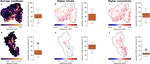
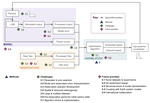
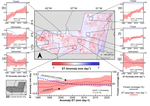
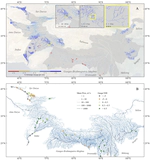
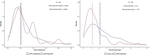
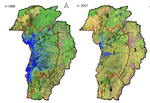
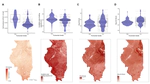
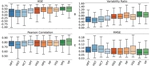
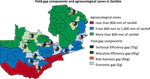
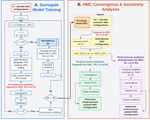
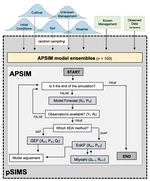
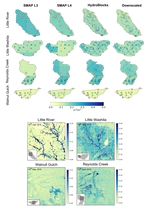
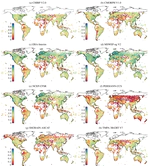
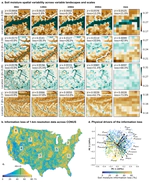
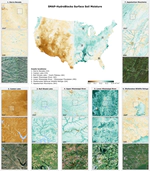
Soil moisture (SM) space and time variability critically influences freshwater resources, agriculture, ecosystem dynamics, climate and land-atmosphere interactions, and it can also trigger hazards such as droughts, floods, landslides, and aggravate wildfires. Here, we present the first continental assessment of how SM varies at the local scales using SMAP-HydroBlocks. This study maps the SM spatial variability, characterizes the landscape drivers, and quantifies how this variability persists across larger spatial scales. Results revealed striking SM spatial variability across the United States. However, this SM variability does not persist at coarser spatial scales resulting in extensive information loss. This information loss implicates inaccuracies when predicting non-linear SM-dependent hydrological, ecological, and biogeochemical processes using coarse-scale models and satellite estimates.
A global near-real-time soil moisture index monitor for food security using integrated SMOS and SMAP
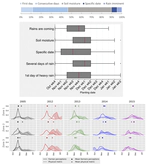
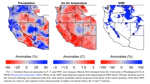
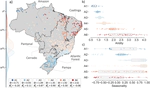
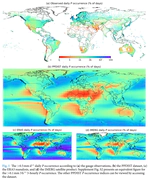
Soil moisture is a direct measure of agricultural drought, yet operational global indices rely on rainfall or model estimates rather than observed soil water in near-real time. We developed the first operational global soil moisture index from merged near-real-time satellite data, mapping daily percentiles at a 7-8 day lag. Over the Canadian Prairies it tracked the dry 2012-2013, wet 2016 and severe 2017 drought.
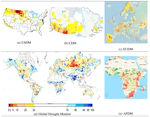
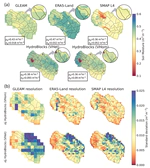
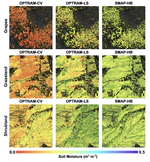
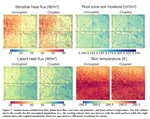
Satellite missions measuring soil moisture from space continue to improve the availability of soil moisture information. However, the utility of these satellite products is limited by the large footprint of the microwave sensors. This study presents a merging framework that combines a hyper-resolution land surface model (LSM), a radiative transfer model (RTM), and a Bayesian scheme to merge and downscale coarse resolution remotely sensed hydrological variables to a 30-m spatial resolution. The framework is based on HydroBlocks, an LSM that solves the field-scale spatial heterogeneity of land surface processes through interacting hydrologic response units (HRUs). Our approach was demonstrated for soil moisture by coupling HydroBlocks with the Tau-Omega RTM used in the Soil Moisture Active Passive (SMAP) mission. The brightness temperature from the HydroBlocks-RTM and SMAP L3 were merged to obtain updated 30-m resolution soil moisture estimates.