Soil vertical heterogeneity reduces rootzone soil moisture bias in hyper-resolution land surface model over smallholder agricultural systems
Abstract
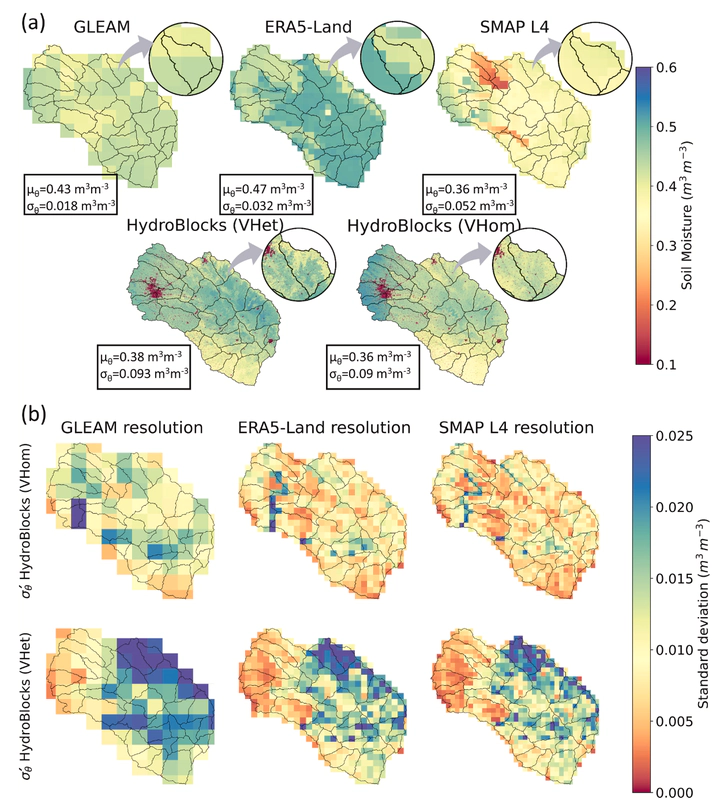
Conventional Land Surface Models operating at coarse resolution inadequately represent soil heterogeneity and typically assume soil hydraulic parameters derived from surface-layer texture are uniform across the column. This introduces systematic errors in rootzone soil moisture simulations whenever soil properties vary with depth. This limitation becomes significant for their application over smallholder agricultural systems, where fine-scale heterogeneity strongly influences soil moisture dynamics. We hypothesize that representing soil hydraulic parameters as vertically heterogeneous improves soil moisture by reducing systematic bias. We modified HydroBlocks, a hyper-resolution land surface model, to incorporate vertical heterogeneity over agriculture-dominated basin in India, representing first such applications in India. Both vertically heterogeneous and homogeneous configurations are evaluated against in-situ observations, SMAP L3/L4, ERA5-Land, and GLEAM products. HydroBlocks simulations show strong temporal consistency with macroscale products while capturing higher sub-grid spatial variability, emphasizing their suitability for agricultural landscapes. At in-situ locations, vertical heterogeneity systematically reduces subsurface soil moisture bias by approximately 14% relative to homogeneous configuration, while ubRMSE and correlation remain unchanged, indicating the model’s ability to correct the mean state while maintaining temporal consistency. Sobol sensitivity analysis across multiple soil layers and seasons reveals that porosity, Brooks-Corey parameter, and wilting point are most influential, with sensitivities varying across layers and interactions intensifying during the monsoon. These results highlight the seasonal and depth-dependent influence of soil hydraulic parameters on soil moisture. The study also demonstrates the potential of hyper-resolution land surface models with vertical heterogeneity to improve farm-scale simulations and support agricultural water management.

Noemi Vergopolan
Assistant Professor of Earth, Environmental and Planetary Sciences
Computational hydrologist working on high-resolution water prediction for climate, agriculture and decision-making.