Abstract
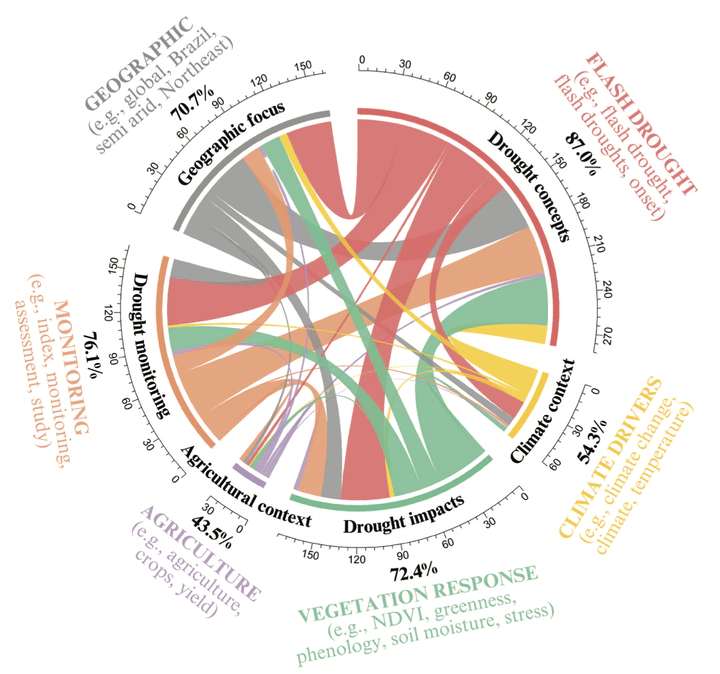
Mostly recognized as a rapid soil moisture decline at drought onset, flash droughts (FDs) threaten food, energy, water, and ecosystem security. Interest in FDs intensified after the 2012 drought in the central US and the 2014 drought in southeastern Brazil. However, studies remain concentrated in the US and China, limiting detectability elsewhere. We reviewed 92 articles (2012–2024) from Web of Science, Scopus, ScienceDirect and SciELO to identify underreported FD events in Brazil. Results show a rise in publications after 2020 and 35 FD definitions, underscoring terminological and methodological diversity. Precipitation–evapotranspiration and soil moisture indicators dominate, followed by vegetation-based indicators. Brazilian hotspots include the Northeast, Central-West, and Southeast, while the North and South remain underexplored. We developed SIRAS-Brazil, an interactive dashboard showing the spatial distribution of studies and hydroclimatic variables. The lack of standardized terminology hinders FD monitoring, along with limited high-resolution data and real-time monitoring capabilities, constraining climate adaptation strategies.

Noemi Vergopolan
Assistant Professor of Earth, Environmental and Planetary Sciences
Computational hydrologist working on high-resolution water prediction for climate, agriculture and decision-making.