Noemi Vergopolan
Noemi Vergopolan
Home
Research
Team
Publications
News & Social
Join Us
Contact
Crops
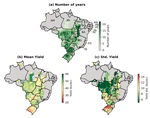
Transfer learning for improved crop yield predictions in a cross-scale pathway: a case study for Brazilian national soybean
Many countries report crop yields only for large administrative units, so models trained on coarse records must be applied at finer scales, where few samples and scale-dependent relationships degrade accuracy. A machine learning model trained on field-level soybean yields in the US Midwest was fine-tuned with Brazilian state-by-year records, a technique called transfer learning, then used to predict municipal yields from 2001 to 2021. Transfer across scales rather than across regions had rarely been tested. Without any municipal training data, explained yield variance rose from 0.29 to 0.44, though transfer added little where fine-scale data were plentiful.
Jiaying Zhang
,
Kaiyu Guan
,
Zhangliang Chen
,
Yizhi Huang
,
Kejie Zhao
,
Bin Peng
,
Sheng Wang
,
Xiaocui Wu
, …,
Noemi Vergopolan
,
et al.
PDF
DOI
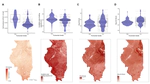
Dynamic geospatial modeling of mycotoxin contamination of corn in Illinois: unveiling critical factors and predictive insights with machine learning
Aflatoxin and fumonisin contamination of corn costs the United States up to an estimated $1.66 billion a year, yet the forecasting models used elsewhere have no US counterpart. Machine learning models were trained on 1,772 mycotoxin measurements from Illinois corn between 2003 and 2021, paired with daily rather than monthly weather, satellite greenness and county soil properties, which sets them apart from an earlier attempt in the state. High contamination events were rare. Even so, the best models reached 96% and 92% balanced accuracy on withheld data. Carbonate-rich soils tracked lower aflatoxin and wetter soils higher fumonisin, relationships that remain correlational.
Lina Castano-Duque
,
Edwin Winzeler
,
Joshua M. Blackstock
,
Cheng Liu
,
Noemi Vergopolan
,
Marlous Focker
,
Kristin Barnett
,
Phillip Ray Owens
,
et al.
PDF
DOI
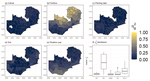
How Much Control do Smallholder Maize Farmers Have Over Yield?
Attributing a smallholder harvest to the farmer’s decisions rather than to soil and weather has been difficult, since field records are scarce. A process-based crop model simulated maize yields across all 72 of Zambia’s districts from 1979 to 2016, varying cultivar, fertilizer rate and planting date, which resolves those three choices separately for the first time nationally. Management explained 53% of yield variance overall, from 27% in the drier south to 82% in the wetter north, where fertilizer alone accounted for 72%.
Michael Cecil
,
Allan Chilenga
,
Charles Chisanga
,
Nicolas Gatti
,
Natasha Krell
,
Noemi Vergopolan
,
Kathy Baylis
,
Kelly Caylor
,
et al.
PDF
DOI
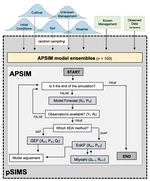
A comprehensive assessment of in situ and remote sensing soil moisture data assimilation in the APSIM model for improving agricultural forecasting across the U.S. Midwest
Soil water is a major uncertainty in crop models, and correcting it against measured soil moisture can reduce uncertainty on yield gain estimation. We tested 19 site-years of corn and soybean at five US Midwest sites, 2011 to 2019, and tested such corrections using in-situ sensors and satellite soil moisture, including SMAP-HydroBlocks, a 30-meter product not previously used in a crop model. Sensors improved yield estimates in 63% of site-years, mostly under water stress. The satellite data constrained the soil profile far more weakly yet still cut yield error by a median 17.2%.
Marissa Kivi
,
Noemi Vergopolan
,
Hamze Dokoohaki
PDF
DOI
Field-scale soil moisture bridges the spatial-scale gap between drought monitoring and agricultural yields
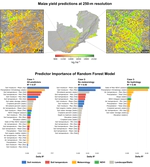
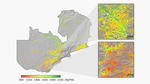
Drought monitoring and yield prediction often rely on coarse-scale hydroclimate data or (infrequent) vegetation indexes that do not always indicate the conditions farmers face in the field. Consequently, decision-making based on these indices can often be disconnected from the farmer reality. Our study focuses on smallholder farming systems in data-sparse developing countries, and it shows how field-scale soil moisture can leverage and improve crop yield prediction and drought impact assessment.
Noemi Vergopolan
,
Sitian Xiong
,
Lyndon Estes
,
Niko Wanders
,
Nathaniel W. Chaney
,
Eric F. Wood
,
Megan Konar
,
Kelly Caylor
,
et al.
PDF
Cite
Project
DOI
Field-scale Crop Yield Prediction
Satellite observations, physical models, and machine learning combined can enable crop yield prediction at high spatial resolution at data-scarse regions. Learn more about it
here
.
Last updated on Sep 28, 2026
From Hydroclimate Data to Science-Informed Decisions
Integrating computational models and hydroclimate data for actionable agriculture decision-making. Towards resilience and adaptability in a changing climate.
Last updated on Sep 11, 2023
Cognitive Biases about Climate Variability in Smallholder Farming Systems in Zambia
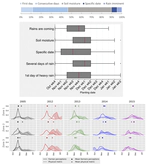
Farmers’ climate perceptions guide adaptation, but previsouly they have been tested against weather stations rather than soil moisture, which matters more for crops. We used surveys of 1,171 Zambian farm households after the 2016 harvest recalled onset dates for recent and earlier seasons. In our analysis each farmer’s own onset rule was compared with local rainfall and modeled soil moisture. Some 88% reported rains arriving 21.9 days later than a decade ago, yet the mean perceived onset for the latest season nearly matched the physically derived mean. Recall bias sets in as early as a year after harvest, and planting rules track maize planting dates, so policy should target current variability over future change.
Kurt B. Waldman
,
Noemi Vergopolan
,
Shahzeen Z. Attari
,
Justin Sheffield
,
Lyndon D. Estes
,
Kelly K. Caylor
,
Tom P. Evans
PDF
Cite
DOI
Comparing empirical and survey-based yield forecasts in a dryland agro-ecosystem
Governments forecast harvests partly from farmers’ mid-season yield expectations, which may be biased. Data from field surveys are often late and costly. Zambia’s maize forecast and post-harvest surveys were compared by district over six seasons from 2001 to 2012, alongside yield models built from weather and soil data. Forecasts averaged above the harvests later recorded, with a typical district-level error of 780 kilograms per hectare, 56% of mean recorded yield. A machine learning model cut that by 13.3%, beating the survey even on pre-planting weather. A major limitations is that models fitted to past weather-yield relationships, may underperform on unprecendented climate extremes.
Yi Zhao
,
Noemi Vergopolan
,
Kathy Baylis
,
Jordan Blekking
,
Kelly Caylor
,
Tom Evans
,
Stacey Giroux
,
Justin Sheffield
,
et al.
PDF
Cite
DOI
Cite
×