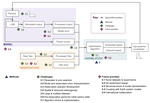
Land surface models, which simulate vegetation, soil, water and carbon within Earth system models, depend on parameters that often cannot be measured directly. Varying one carbon flux parameter within its uncertainty range can shift projected atmospheric CO2 in 2100 more than the choice of emissions scenario. This review presents two decades of work on adjusting parameters to match observations is consolidated into seven recurring obstacles, each paired with a machine learning opportunity.